At-home microcurrent devices
NuFACE · FOREO Bear · 'face gym'
Handheld microcurrent wands are marketed as a 'five-minute facelift' and a 'workout for your face', a favourite of get-ready-with-me videos and gift guides.
Search interest: about 200 searches a month in Singapore for “nuface” (Ahrefs, October 2026).
A rented look. The lift lasts about as long as the gel is wet, and it detrains the moment you stop. Fine as a ritual; it is not what moves a jawline.
Reviewed against the Aesthetics International standard. Category: At-home.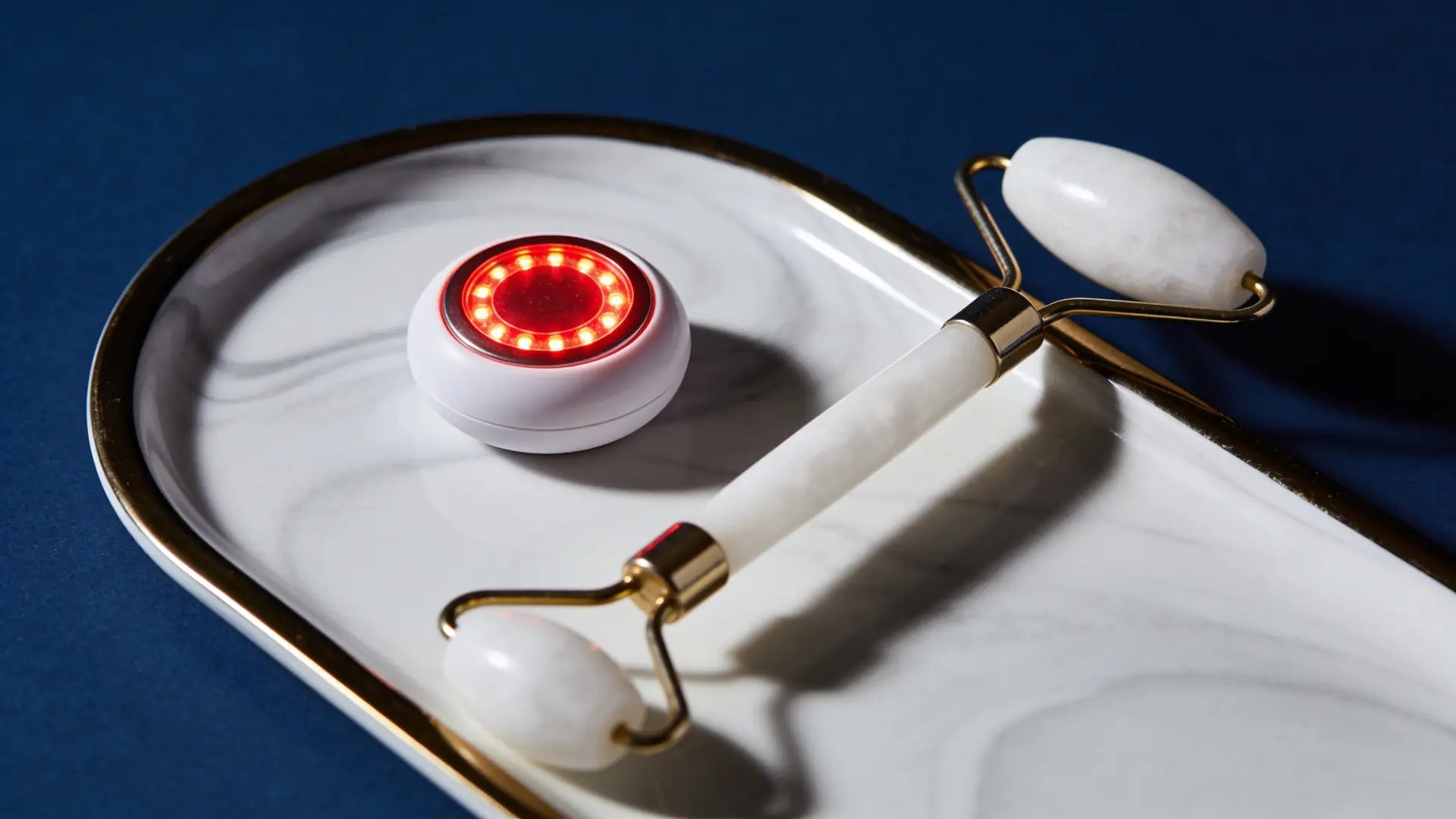
Do At-home microcurrent devices work?
Trend. A rented look. The lift lasts about as long as the gel is wet, and it detrains the moment you stop. Fine as a ritual; it is not what moves a jawline. The most-cited trial used a neuromuscular stimulation device — strong enough to contract muscle — for 20 minutes a day, five days a week, for 12 weeks, and reported a measured increase in zygomatic muscle thickness and subjective improvement, with no sham arm.
- Verdict
- Trend Popular for reasons that are mostly social. Harmless at best; manage expectations.
- Evidence base
- 3 PubMed-indexed studies cited below, including randomised trials.
- Suits
- People who want a few hours of de-puffing before an event and enjoy a daily ritual; early, mild laxity in a younger face as a complement rather than a plan.
- Not for
- Pacemakers, epilepsy, pregnancy, metal implants in the face, recent injectables, and anyone expecting a lasting lift.
- In Singapore
- Consumer devices sold freely in Singapore; several carry US FDA clearance, which indicates equivalence to an earlier device rather than proof of effect.
- Category
- At-home · about 200 searches a month in Singapore for “nuface”
- Reviewed
- 1 October 2026 by Aesthetics International. Revised as evidence and regulation change.
What it is
Devices that pass a very low electrical current, below the level that causes a visible twitch, through two metal spheres glided over conductive gel on the face. The claim is that the current tones facial muscles and boosts cellular energy, lifting the brow and jawline.
How it works
Microcurrent is proposed to increase ATP production and briefly contract or 're-educate' the elevator muscles, with a short-lived tightening and de-puffing effect. Consumer devices deliver far less current than the neuromuscular stimulation used in trials, and any effect reverses when use stops, much as muscle detrains. Nothing about the current changes skin laxity, fat descent or bone.
What the evidence says
The most-cited trial used a neuromuscular stimulation device — strong enough to contract muscle — for 20 minutes a day, five days a week, for 12 weeks, and reported a measured increase in zygomatic muscle thickness and subjective improvement, with no sham arm. A 2024 review of home beauty devices found the longest follow-up in the microcurrent literature was about 12 weeks and called for standardised evaluation. Independent, sham-controlled trials of the consumer wands themselves are lacking; a 2026 review of at-home devices reached the same conclusion. The visible 'lift' in videos is immediate fluid shift and expression.
What people are saying
Paraphrased from public discussion on TikTok, Instagram, Reddit and in the press. Not testimonials, and not about any one clinic. Reported in: nbcnews.com, dermapproved.com.
What the studies show
- RCT
Twelve weeks of facial neuromuscular stimulation increased zygomatic muscle thickness on ultrasound versus a no-treatment control; the device delivered visible contractions and there was no sham arm.
Use of a neuromuscular electrical stimulation device for facial muscle toning: a randomized, controlled trial. — Journal of Cosmetic Dermatology, 2012. PMID 23174048.
- review
Reviewed home-device studies including microcurrent and found short follow-up and inconsistent methods, proposing a standard evaluation framework.
Development of Home Beauty Devices for Facial Rejuvenation: Establishment of Efficacy Evaluation System. — Clinical, Cosmetic and Investigational Dermatology, 2024. PMID 38476342.
- review
Summarised the evidence for at-home devices as generally safe with modest, device-dependent efficacy and a shortage of controlled trials.
The Safety and Efficacy of At-Home Devices for Skin Care. — Facial Plastic Surgery, 2026. PMID 42184823.
Studies are selected for relevance and quality, not for agreement with the verdict; PubMed records are linked so the reader can check them.
Who it suits
Suits
People who want a few hours of de-puffing before an event and enjoy a daily ritual; early, mild laxity in a younger face as a complement rather than a plan.
Not for
Pacemakers, epilepsy, pregnancy, metal implants in the face, recent injectables, and anyone expecting a lasting lift.
Alternatives
The two reviewed treatments most often weighed against At-home microcurrent devices, on the same standard.
| At-home microcurrent devices | Pico laser | HIFU | |
|---|---|---|---|
| Verdict | Trend | Vetted | Vetted |
| What it is | Devices that pass a very low electrical current, below the level that causes a visible twitch, through two metal spheres glided over conductive gel on the face. | A picosecond laser delivers energy in pulses a thousand times shorter than the nanosecond lasers that came before it. | High-intensity focused ultrasound delivers heat to precise points at set depths — commonly 1.5, 3.0 and 4.5 mm — creating coagulation points in the dermis and the SMAS layer that contract and stimulate collagen over months. |
| Evidence base | 3 PubMed-indexed studies cited below, including randomised trials. | 4 PubMed-indexed studies cited below, including systematic reviews. | 3 PubMed-indexed studies cited below, including systematic reviews. |
| Suits | People who want a few hours of de-puffing before an event and enjoy a daily ritual; early, mild laxity in a younger face as a complement rather than a plan. | Sun spots, freckles, post-acne marks, tattoo ink, uneven tone in Asian skin when energy is set conservatively. | Mild to moderate laxity with reasonable skin thickness, people who want a structural effect without injectables. |
| In one line | A rented look. The lift lasts about as long as the gel is wet, and it detrains the moment you stop. Fine as a ritual; it is not what moves a jawline. | The variable that matters is depth, not brightness, and pigment already deposited is only half the problem; the inflammation producing it is the other half. | HIFU or radiofrequency is the wrong question — they do not do the same job, which is why 3D Facial Reconstruction uses both. |
Risks
Minimal: transient redness, metallic taste, rare headache. The main cost is time and money.
In Singapore
Consumer devices sold freely in Singapore; several carry US FDA clearance, which indicates equivalence to an earlier device rather than proof of effect.
“A rented look. The lift lasts about as long as the gel is wet, and it detrains the moment you stop. Fine as a ritual; it is not what moves a jawline.”
Vetted protocols on the same problem
Questions
Does microcurrent lift the face?
How often would I need to use it?
Microcurrent or radiofrequency?
Cite this review
Aesthetics International (2026). At-home microcurrent devices: does it work? Evidence, risks and verdict. https://aesthetics-international.org/treatments/at-home-microcurrent/ (reviewed 1 October 2026).
Editorial, unpaid and independent of any manufacturer. Verdict: Trend. See what works and what doesn't across all 153 reviews. Spotted an error or a newer study? Suggest a correction — changes are logged on the corrections page. Terms are defined in the glossary.
Where this review is used
Have a question about this treatment?
Ask us — or ask to be matched with a practitioner in Singapore who follows evidence-based treatment. Whether it is right for you is decided at an in-person assessment, not by a review; sometimes the answer is a different treatment, or none.
WhatsApp +65 8023 7170Suggest a treatment to review
Physicians, manufacturers and readers can propose a treatment for review. Reviews are editorial and are not paid for.
[email protected]